Translate

Showing posts with label Ames Research Center. Show all posts

Thursday, November 21, 2013

NASA Spacecraft Begins Collecting Lunar Atmosphere Data

Nov. 21, 2013

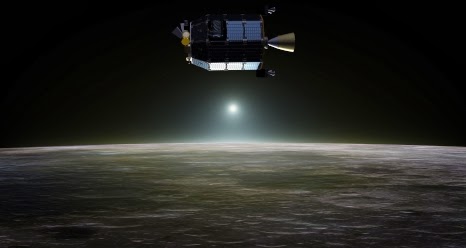
Artist’s concept of NASA's Lunar Atmosphere and Dust Environment Explorer (LADEE) spacecraft
Image Credit: NASA Ames / Dana Berry
NASA's Lunar Atmosphere and Dust Environment Explorer (LADEE) is ready to begin collecting science data about the moon.

On Nov. 20, the spacecraft successfully entered its planned orbit around the moon's equator -- a unique position allowing the small probe to make frequent passes from lunar day to lunar night. This will provide a full scope of the changes and processes occurring within the moon's tenuous atmosphere.

LADEE now orbits the moon about every two hours at an altitude of eight to 37 miles (12-60 kilometers) above the moon's surface. For about 100 days, the spacecraft will gather detailed information about the structure and composition of the thin lunar atmosphere and determine whether dust is being lofted into the lunar sky.

"A thorough understanding of the characteristics of our lunar neighbor will help researchers understand other small bodies in the solar system, such as asteroids, Mercury, and the moons of outer planets," said Sarah Noble, LADEE program scientist at NASA Headquarters in Washington.

Scientists also will be able to study the conditions in the atmosphere during lunar sunrise and sunset, where previous crewed and robotic missions detected a mysterious glow of rays and streamers reaching high into the lunar sky.

“This is what we've been waiting for – we are already seeing the shape of things to come,” said Rick Elphic, LADEE project scientist at NASA's Ames Research Center in Moffett Field, Calif.

Continue Learning: http://www.nasa.gov/content/nasa-spacecraft-begins-collecting-lunar-atmosphere-data/#.Uo7JjfmKK-0

Monday, November 18, 2013

Ames to pitch NASA on value of 'new' Kepler mission

By Stephen Clark
ASTRONOMY NOW
Posted: 16 November 2013

Artist's concept of the Kepler spacecraft. Credit: NASA/Ames
Managers in charge of the Kepler telescope have identified a way of salvaging the crippled observatory for a modified, less-sensitive cosmic survey for alien worlds, but NASA may not have the money to pay for the mission.

Since Kepler was knocked offline in May, officials at NASA's Ames Research Center in California have considered and analyzed new missions for the telescope.

And they think they have found a concept that is both feasible and scientifically intriguing.

The new mission scenario, dubbed "K2," calls for pointing Kepler across a swath of sky known as the ecliptic plane, or the plane where all the solar system's planets orbit the sun.

If approved by NASA Headquarters, the renewed Kepler campaign would be a shift from looking at stars like the sun to observing smaller, cooler stars that may harbor rocky planets close in, meaning they would be easier to detect.

"This is science that Kepler can do, and the K2 mission can do this uniquely, so this is really a selling point," said Steve Howell, Kepler's project scientist, during a Nov. 4 presentation at the second Kepler Science Conference held at Ames.

Plagued by reaction wheels and unable to adequately control its roll motion, Kepler is no longer capable of holding its gaze toward a field of more than 150,000 stars in the constellations Cygnus and Lyra. Kepler's optical detectors kept up a near-contant stare at the star field, which was selected because it was representative of the rest of the Milky Way, allowing scientists to extend their findings predict what may lie elsewhere in the sky.

Continue Learning: http://www.astronomynow.com/news/n1311/16kepler/#.UojvPvmKK-0

Saturday, November 16, 2013

NASA Looks To Small Businesses For Big Space Programs

NASA Looks To Small Businesses For Big Space Programs

November 15, 2013
Image Credit: Thinkstock.com
NASA is seeking proposals for the agency’s Small Business Innovation Research and Small Business Technology Transfer (SBIR/STTR) programs to enable future space exploration while helping to seed viable commercial products and services here in the US.

Small businesses and nonprofit research institutions that participate in the SBIR and STTR Programs are provided with opportunities to address specific technology gaps in NASA missions. The programs stimulate opportunities for the commercialization of new technologies developed through federal research and development. Many NASA efforts have been aided through the program results, such as modern air traffic control systems, Earth and sun observing spacecraft, the International Space Station (ISS), planetary and astrophysics science missions and the technologies needed for human exploration beyond low-Earth orbit.

Continue Learning: http://www.redorbit.com/news/space/1113004473/small-business-key-for-nasa-space-program-111513/