Translate

Showing posts with label Astronomy. Show all posts

Monday, December 16, 2013

The death of the universe - Renée Hlozek


Published on Dec 12, 2013

View full lesson: http://ed.ted.com/lessons/the-death-o...

The shape, contents and future of the universe are all intricately related. We know that it's mostly flat; we know that it's made up of baryonic matter (like stars and planets), but mostly dark matter and dark energy; and we know that it's expanding constantly, so that all stars will eventually burn out into a cold nothingness. Renée Hlozek expands on the beauty of this dark ending.

Lesson by Renée Hlozek, animation by Giant Animation Studios.

(See More Videos)

Why extremophiles bode well for life beyond Earth - Louisa Preston


Published on Oct 7, 2013

View full lesson: http://ed.ted.com/lessons/why-extremo...

Life on Earth requires three things: liquid water, a source of energy within a habitable range from the sun and organic carbon-based material. But life is surprisingly resilient, and organisms called extremophiles can be found in hostile living conditions (think extreme temperatures and little access to oxygen). Louisa Preston argues why extremophiles give astrobiologists hope for life in the universe.

Lesson by Louisa Preston, animation by Emanuel Friberg.

Wednesday, November 27, 2013

Guide to our Galaxy


Published on Nov 21, 2013

This virtual journey shows the different components that make up our home galaxy, the Milky Way, which contains about a hundred billion stars.

It starts at the black hole at the centre of the Milky Way and with the stars that orbit around it, before zooming out through the central Galactic Bulge, which hosts about ten billion stars.

The journey continues through a younger population of stars in the stellar disc, home to most of the Milky Way's stars, and which is embedded in a slightly larger gaseous disc. Stars in the disc are arranged in a spiral arm pattern and orbit the centre of the Galaxy.

The discs and bulge are embedded in the stellar halo, a spherical structure that consists of a large number of globular clusters -- the oldest population of stars in the Galaxy -- as well as many isolated stars. An even larger halo of invisible dark matter is inferred by its gravitational effect on the motions of stars in the Galaxy.

Looking at a face-on view of the Galaxy we see the position of our Sun, located at a distance of about 26 000 light-years from the Galactic Centre.

Finally, the extent of the stellar survey conducted by ESA's Hipparcos mission is shown, which surveyed more than 100 000 stars up to 300 light-years away from the Sun. In comparison, ESA's Gaia survey will study one billion stars out to 30 000 light-years away.

(See More Videos)

3D virtual tour of the International Space Station

Published on Nov 19, 2013

Put your 3D glasses on for this virtual visit of the International Space Station's modules. Float through the space laboratories and connecting modules from the perspective of an astronaut.

(See More Videos)

Tuesday, November 26, 2013

With 2 More Cubesats in Orbit, Earth-imaging Startup Planet Labs Ships Next Batch of 28 to Wallops

By Debra Werner | Nov. 26, 2013

Planet Labs is preparing for the scheduled launch Dec. 15 of its operational Earth imaging constellation of 28 satellites, dubbed Flock 1, to the international space station.
Credit: Photo by Gabriel Liendo
SAN FRANCISCO — Planet Labs, the San Francisco company planning to establish the world’s largest Earth imaging constellation, announced Nov. 26 the successful launch of two satellites and shipment to Virginia of 28 additional spacecraft in preparation for their December launch.

On Nov. 21, Planet Labs sent triple cubesats Dove 3 and Dove 4 into polar orbit on a Dnepr rocket from Russia’s Yasny launch site. “The launch was extremely successful,” said William Marshall, Planet Labs co-founder and chief executive. “They went into precisely the orbit we wanted. We have also successfully made contact.”

The latest additions to the Planet Labs fleet offer improvements in the capability provided by the firm’s first satellites launched in April, Dove 1 and Dove 2, which also were triple cubesats measuring 10 centimeters by 10 centimeters by 30 centimeters.

Dove 3 and Dove 4 will demonstrate the firm’s latest technology, including upgraded communications, attitude control and observation technology. “We like to iterate our satellite designs very rapidly,” Marshall said. “It’s the same compact form factor as Dove 1 and Dove 2, but we have stuck in more capability.”

Continue Learning: http://www.spacenews.com/article/civil-space/38361with-2-more-cubesats-in-orbit-earth-imaging-startup-planet-labs-ships-next

Hi-Def Space Selfies Coming To Your Web Browser Soon

Posted by Andrew Fazekas in StarStruck on November 25, 2013

Space buffs can expect to to ogle stunning near-real-time Earth views anytime on their computers and mobile devices once new HD cameras are installed on the International Space Station.
Credit: NASA
Coming soon—take the ultimate selfie from space!

Two high-definition cameras are on their way now to the International Space Station. There, they will aim to revolutionize how we view our planet and ourselves.

A Canadian-based company named UrtheCast will offer the world’s first near-live HD video and imagery of Earth from space, using the new cameras. Launched aboard a Russian Soyuz spacecraft on Monday, the two eyes in the sky will be installed on the underbelly of the space station over the next few months. Expectations are that space buffs everywhere with an internet connection will see the first live streaming-video broadcast from the cameras on the company’s web portal early next year.

One of the cameras will offer sharp five-meter resolution stills of a broad 25-mile-wide (40 kilometer) swath of the globe, with pictures taken anywhere between 51°N and 51°S latitude (from England to Chile). The other camera can be pointed at 150 specific targets of interest per day. It has the capability of generating video with super-sharp Ultra-HD or 4K quality, and offers one-meter resolution.

Continue Learning: http://newswatch.nationalgeographic.com/2013/11/25/hi-def-space-selfies-coming-to-your-web-browser-soon/


Related articles

Monday, November 25, 2013

SES-8 Satellite Launch Will Be SpaceX’s Most Challenging To Date

November 25, 2013

A September test launch of SpaceX’s Falcon 9 rocket. Credit: SpaceX
Lawrence LeBlond for redOrbit.com – Your Universe Online

SpaceX is preparing for its next big mission this evening when it will, for the first time, attempt to launch a telecom satellite into orbit. A successful launch could prove the Elon Musk-owned company’s worth as both a private and commercial powerhouse in the space launch game.

The launch window for SpaceX’s Falcon 9 opens today at 5:37 p.m. EST from Cape Canaveral, Florida. The rocket will be carrying a Luxembourg-based SES-8 satellite that will serve television customers in India and parts of Southeast Asia.

The launch of a satellite is not only a first for SpaceX, but will also be its most challenging. The Falcon 9 rocket must show its capabilities in launching the SES-8 satellite into a geostationary transfer orbit more than 22,000 miles over Earth’s equator.

Today’s launch of an upgraded Falcon 9 rocket, known as version 1.1, also comes after a September 29 test launch of the same rocket design in California. While that test was successful, an optional restart of the rocket’s upper stage engine, which will be necessary for the latest mission, failed to activate.

SpaceX later determined that an igniter line froze and believes that added insulation will prevent a repeat of the issue.

“We’ve done everything we can possibly think of to maximize the reliability of this launch,” Musk, CEO and chief designer at SpaceX, told BBC’s Jonathan Amos in an interview

“There’s no stone that hasn’t been turned over at least twice to maximize the probability of success. Being a rocket, there’s still some chance of failure, but whatever happens we can be at peace that we’ve done everything we could think of, and SES’s technical team has looked at it and they concur,” Musk added.

Continue Learning: http://www.redorbit.com/news/space/1113012115/spacex-launch-commercial-satellite-tonight-most-challenging-112513/

Saturday, November 23, 2013

2014 NASA Rover Challenge

2014 NASA Rover Challenge
NASA is introducing a new engineering design challenge that will focus on NASA’s current plans to explore planets, moons, asteroids and comets -- all members of the solar system family. The new NASA Rover Challenge (formerly NASA Great Moonbuggy Race) will be held April 10-12, 2014, at the U. S. Space & Rocket Center. The challenge will focus on designing, constructing and testing technologies for mobility devices to perform in these different environments, and it will provide valuable experiences that engage students in the technologies and concepts that will be needed in future exploration missions. Registration is OPEN!

Visit the registration section of this site for details.

Is Inspiration Enough To Launch Inspiration Mars?

NASA By Amy Shira Teitel Posted Nov. 22, 2013

An artist’s concept of Inspiration Mars Inspiration Mars
Credit: Inspiration Mars
In 2001, Dennis Tito used his millions to buy a seat on a Soyuz spacecraft for an eight-day visit to the International Space Station. On February 27 of this year, he announced his plan to foot a large portion of the bill for Inspiration Mars, a flyby mission to the red planet. On Wednesday in front of a House Committee on Space, he called for NASA to pick up the slack to see his mission fly, both financially and technologically. Inspiration Mars had some obvious problems from the start, but this latest development looks a little like it might be the first nail in the mission’s coffin.

Tito unveiled Inspiration Mars earlier this year as a philanthropic mission; technological and scientific ends were secondary to the primary goal of inspiring the nation to aspire to great things in space once again. The mission itself is fairly straightforward. A crew of two (a married, middle-aged, heterosexual couple) will launch in January of 2018, fly to Mars, and whip around the planet’s far side using gravity to boost them back to Earth. The mission isn’t designed to land on Mars of even go into orbit. It would be a 501 day flight with a very short but exciting flyby around one of our neighbours.

Continue Learning: http://www.popsci.com/blog-network/vintage-space/inspiration-enough-launch-inspiration-mars

Clock Ticking for 2018 Private Manned Mars Mission

By Mike Wall, Senior Writer | November 21, 2013 06:00am ET

An artist’s illustration of the manned spacecraft for the Inspiration Mars
mission to send two astronauts on a Mars flyby mission in 2017-2018.
Credit: Inspiration Mars
A private manned Mars mission won’t get off the ground as planned in January 2018 unless it secures the support of the federal government within the next few months, officials say.

The nonprofit Inspiration Mars Foundation aims to partner with NASA to send two astronauts on a flyby mission to the Red Planet in 2018. Inspiration Mars has little chance of making this launch date unless it receives assurances very soon from Congress and the White House that the mission will be a NASA priority, officials said.

“We have a just a couple of months to get some signals that would indicate that there’s serious interest developing,” Inspiration Mars founder Dennis Tito, who became the world’s first space tourist when he paid his own way to the International Space Station in 2001, told reporters during a teleconference Wednesday (Nov. 20). “So, not much time.” [Private Mission to Mars Explained (Infographic)]

Inspiration Mars’ “Mission for America” would launch a married couple on a 501-day flyby mission to the Red Planet in January 2018. The astronauts would not land on Mars, but would streak within 100 miles (160 kilometers) of its surface before beginning the long trek back to Earth.

The mission would lay the foundation for even more ambitious exploration efforts in the future and help cement the United States’ status as a global leader in science and technology by inspiring the next generation of researchers and engineers, Inspiration Mars officials say.

Continue Learning: http://www.space.com/23678-inspiration-mars-manned-mission-deadline.html

Discovery Of Cosmic Neutrinos Signals New Era Of Astronomy

November 21, 2013

Computers at the IceCube laboratory collect raw data in near-real time from detectors buried deep in the Antarctic ice.
Credit: Felipe Pedreros, IceCube/NSF
Lee Rannals for redOrbit.com – Your Universe Online

Astronomers working with the IceCube Neutrino Observatory in Antarctica have announced that they have, for the first time, observed 28 very high-energy particle events, leading them to conclude that “the era of neutrino astronomy has begun.”

Cosmic neutrinos are nearly massless particles that stream to Earth at the speed of light from outside our solar system. This observation, published in the journal Science, will allow scientists to learn about the nature of astrophysical phenomena that occurs millions to billions of light years away from Earth.

“The sources of neutrinos, and the question of what could accelerate these particles, has been a mystery for more than 100 years. Now we have an instrument that can detect astrophysical neutrinos. It’s working beautifully, and we expect it to run for another 20 years,” Gregory Sullivan, who led the team from University of Maryland, said in a statement.

Between May 2010 and May 2012, the IceCube detector at the South Pole captured a total of 28 neutrinos with energies greater than 30 teraelectronvolts (TeV). Two of the neutrinos had an energy of more than 1,000 TeV, which is more than the kinetic energy of a flying bug.

“This is the first indication of very high-energy neutrinos coming from outside our solar system,” said Francis Halzen, principal investigator of IceCube and the Hilldale and Gregory Breit Distinguished Professor of Physics at the University of Wisconsin-Madison.

Continue Learning: http://www.redorbit.com/news/space/1113010258/icecube-cosmic-neutrino-discovery-astronomy-112113/

NASA | How to Cook a Comet


Published on Nov 21, 2013

(See More Videos)

A comet's journey through the solar system is perilous and violent. Before it reaches Mars - at some 230 million miles away from the sun - the radiation of the sun begins to cook off the frozen water ice directly into gas. This is called sublimation. It is the first step toward breaking the comet apart. If it survives this, the intense radiation and pressure closer to the sun could destroy it altogether.

Animators at NASA's Goddard Space Flight Center in Greenbelt, Md. created this short movie showing how the sun can cook a comet.

Such a journey is currently being made by Comet ISON. It began its trip from the Oort cloud region of our solar system and is now traveling toward the sun. The comet will reach its closest approach to the sun on Thanksgiving Day -- Nov. 28, 2013 -- skimming just 730,000 miles above the sun's surface. If it comes around the sun without breaking up, the comet will be visible in the Northern Hemisphere with the naked eye, and from what we see now, ISON is predicted to be a particularly bright and beautiful comet.

Even if the comet does not survive, tracking its journey will help scientists understand what the comet is made of, how it reacts to its environment, and what this explains about the origins of the solar system. Closer to the sun, watching how the comet and its tail interact with the vast solar atmosphere can teach scientists more about the sun itself.

This video is public domain and can be downloaded at: http://svs.gsfc.nasa.gov/goto?11384

Like our videos? Subscribe to NASA's Goddard Shorts HD podcast:
http://svs.gsfc.nasa.gov/vis/iTunes/f...

Or find NASA Goddard Space Flight Center on Facebook:
http://www.facebook.com/NASA.GSFC

Or find us on Twitter:
http://twitter.com/NASAGoddard

Exploring the dark universe at the speed of petaflops

Nov 21, 2013 by Gail Pieper
This visualization, part of a 1.1-trillion-particle simulation run on Argonne’s supercomputer
Mira, shows the complexity of cosmological structure formation.
Image via Phys.org
An astonishing 95% of our universe is made of up dark energy and dark matter. Understanding the physics of this sector is the foremost challenge in cosmology today. Sophisticated simulations of the evolution of the universe play a crucial role.

The primary lens through which scientists look at the night sky is no longer only a telescope—it's also a supercomputer. The new and coming generations of supercomputers will finally be capable of modeling the universe in the detail and volume required by astronomical surveys of the sky that are now underway, or soon will be.

Scientists use large cosmological simulations to test theories about the structure of the universe and the evolution of the distribution of galaxies and clusters of galaxies. State-of-the-art supercomputers let cosmologists make predictions and test them against data from powerful telescopes and space probes. Two decades of surveying the sky have culminated in the celebrated Cosmological Standard Model. Yet two of the model's key pillars—dark matter and dark energy, together accounting for 95% of the universe—remain mysterious. A research team led by Argonne is tackling this mystery, aided by some of the world's fastest supercomputers.

Continue Learning: http://phys.org/news/2013-11-exploring-dark-universe-petaflops.html

Related articles

Friday, November 22, 2013

China's 1st Moon Lander May Cause Trouble for NASA Lunar Dust Mission

by Leonard David, SPACE.com's Space Insider Columnist | November 21, 2013 06:45am ET

The Chang’e 3 lunar lander and moon rover
Credit: Beijing Institute of Spacecraft System Engineering
China’s mission to robotically land on the moon next month is sure to stir up lunar dust, but it may also cause a political dust up, too.

China is in the final stages of preparing its robotic Chang’e 3 moon lander to launch atop a Long March 3B rocket, slated for liftoff in early December. The ambitious mission is built to first orbit the moon, then propel down to a landing site, after which a small, solar-powered lunar rover will be unleashed.

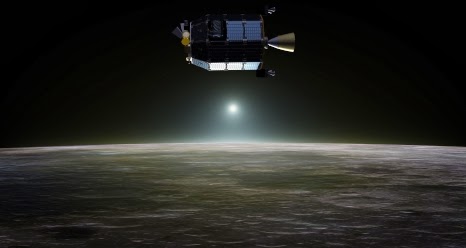
Already on duty orbiting the moon is NASA’s Lunar Atmosphere and Dust Environment Explorer (LADEE). The probe’s science instrument commissioning is now underway, after which the spacecraft will drop down to the lower lunar science orbit and start the full science phase of the mission. [NASA's LADEE Moon Mission in Photos]

LADEE Readies for Orbital Maneuvering Thruster Burn
Credit: NASA Ames/Dana Berry


LADEE is designed to study the moon’s thin exosphere and the lunar dust environment. However, there is concern that China’s ambitious Chang’e 3 mission could impact LADEE’s science goals.

Continue Learning: http://www.space.com/23675-china-moon-lander-trouble-nasa-ladee.html
Related articles
NASA Spacecraft Begins Collecting Lunar Atmosphere Data (askkuiper.wordpress.com)
NASA Moon Probe Laser-Blasts Europe! (askkuiper.wordpress.com)

NASA sees 'watershed' cosmic blast in unique detail

Posted: Nov 21, 2013 by Francis Reddy

In the most common type of gamma-ray burst, illustrated here, a dying massive star forms a
black hole (left), which drives a particle jet into space.
Credit: NASA's Goddard Space Flight Center
(Phys.org) —On April 27, a blast of light from a dying star in a distant galaxy became the focus of astronomers around the world. The explosion, known as a gamma-ray burst and designated GRB 130427A, tops the charts as one of the brightest ever seen

A trio of NASA satellites, working in concert with ground-based robotic telescopes, captured never-before-seen details that challenge current theoretical understandings of how gamma-ray bursts work.

"We expect to see an event like this only once or twice a century, so we're fortunate it happened when we had the appropriate collection of sensitive space telescopes with complementary capabilities available to see it," said Paul Hertz, director of NASA's Astrophysics Division in Washington.

Gamma-ray bursts are the most luminous explosions in the cosmos, thought to be triggered when the core of a massive star runs out of nuclear fuel, collapses under its own weight, and forms a black hole. The black hole then drives jets of particles that drill all the way through the collapsing star and erupt into space at nearly the speed of light.

Gamma-rays are the most energetic form of light. Hot matter surrounding a new black hole and internal shock waves produced by collisions within the jet are thought to emit gamma-rays with energies in the million-electron-volt (MeV) range, or roughly 500,000 times the energy of visible light. The most energetic emission, with billion-electron-volt (GeV) gamma rays, is thought to arise when the jet slams into its surroundings, forming an external shock wave.

The Gamma-ray Burst Monitor (GBM) aboard NASA's Fermi Gamma-ray Space Telescope captured the initial wave of gamma rays from GRB 130427A shortly after 3:47 a.m. EDT April 27. In its first three seconds alone, the "monster burst" proved brighter than almost any burst previously observed.

Continue Learning: http://phys.org/news/2013-11-nasa-watershed-cosmic-blast-unique.html
Related articles
Infant Galaxies Merge Near 'Cosmic Dawn' (askkuiper.wordpress.com)
Ames to pitch NASA on value of 'new' Kepler mission (askkuiper.wordpress.com)
NASA Spacecraft Begins Collecting Lunar Atmosphere Data (askkuiper.wordpress.com)

Thursday, November 21, 2013

NASA Spacecraft Begins Collecting Lunar Atmosphere Data

Nov. 21, 2013

Artist’s concept of NASA's Lunar Atmosphere and Dust Environment Explorer (LADEE) spacecraft
Image Credit: NASA Ames / Dana Berry
NASA's Lunar Atmosphere and Dust Environment Explorer (LADEE) is ready to begin collecting science data about the moon.

On Nov. 20, the spacecraft successfully entered its planned orbit around the moon's equator -- a unique position allowing the small probe to make frequent passes from lunar day to lunar night. This will provide a full scope of the changes and processes occurring within the moon's tenuous atmosphere.

LADEE now orbits the moon about every two hours at an altitude of eight to 37 miles (12-60 kilometers) above the moon's surface. For about 100 days, the spacecraft will gather detailed information about the structure and composition of the thin lunar atmosphere and determine whether dust is being lofted into the lunar sky.

"A thorough understanding of the characteristics of our lunar neighbor will help researchers understand other small bodies in the solar system, such as asteroids, Mercury, and the moons of outer planets," said Sarah Noble, LADEE program scientist at NASA Headquarters in Washington.

Scientists also will be able to study the conditions in the atmosphere during lunar sunrise and sunset, where previous crewed and robotic missions detected a mysterious glow of rays and streamers reaching high into the lunar sky.

“This is what we've been waiting for – we are already seeing the shape of things to come,” said Rick Elphic, LADEE project scientist at NASA's Ames Research Center in Moffett Field, Calif.

Continue Learning: http://www.nasa.gov/content/nasa-spacecraft-begins-collecting-lunar-atmosphere-data/#.Uo7JjfmKK-0

Wednesday, November 20, 2013

NASA's Chandra Helps Confirm Evidence of Jet in Milky Way's Black Hole

Nov. 20, 2013

Composite image of Sagittarius A* (Sgr A*), the supermassive black hole at the center of the Milky Way.
Image Credit: X-ray: NASA/CXC/UCLA/Z. Li et al; Radio: NRAO/VLA
Astronomers have long sought strong evidence that Sagittarius A* (Sgr A*), the supermassive black hole at the center of the Milky Way, is producing a jet of high-energy particles. Finally they have found it, in new results from NASA's Chandra X-ray Observatory and the National Science Foundation's Very Large Array (VLA) radio telescope.

Previous studies, using a variety of telescopes, suggested there was a jet, but these reports -- including the orientation of the suspected jets -- often contradicted each other and were not considered definitive.

"For decades astronomers have looked for a jet associated with the Milky Way's black hole. Our new observations make the strongest case yet for such a jet," said Zhiyuan Li of Nanjing University in China, lead author of a study appearing in an upcoming edition of The Astrophysical Journal and available online now.

Jets of high-energy particles are found throughout the universe, on large and small scales. They are produced by young stars and by black holes a thousand times larger than the Milky Way's black hole. They play important roles in transporting energy away from the central object and, on a galactic scale, in regulating the rate of formation of new stars.

"We were very eager to find a jet from Sgr A* because it tells us the direction of the black hole's spin axis. This gives us important clues about the growth history of the black hole," said Mark Morris of the University of California at Los Angeles, a co-author of the study.

The study shows the spin axis of Sgr A* is pointing in one direction, parallel to the rotation axis of the Milky Way, which indicates to astronomers that gas and dust have migrated steadily into Sgr A* over the past 10 billion years. If the Milky Way had collided with large galaxies in the recent past and their central black holes had merged with Sgr A*, the jet could point in any direction.

Continue Learning: http://www.nasa.gov/mission_pages/chandra/news/high-energy-particles-in-milky-way.html#.Uo0-CfmKK-0

Dark Matter Reveals the Structure of the Universe

by BIG THINK EDITORS NOVEMBER 20, 2013, 12:00

Image via Bigthink.com
Physics is both deeply inspiring and deeply humbling, in a way that few other disciplines are today. On the one hand, physicists have found the elusive Higgs boson, the particle responsible for mass. On the other hand, physicists are comparatively clueless when it comes to dark matter, which makes up the vast majority of the Universe.

Comparatively clueless, that is to say, but not completely clueless.

In the video below, Joel Primack, an astrophysicist at the University of California-Santa Cruz, explains that we don’t yet know the real nature of the dark matter “beyond that it’s pretty cold.” Cold refers to the terminology that Primack coined in 1983. Dark matter is either hot, warm or cold “depending on how rapidly it’s moving in the early stages of the Big Bang,” Primack says.

Continue Learning: http://bigthink.com/big-think-tv/dark-matter-reveals-the-structure-of-the-universe?utm_source=feedburner&utm_medium=feed&utm_campaign=Feed%3A+bigthink%2Fmain+(Big+Think+Main)

Martian Geology More Diverse Than Previously Thought

November 18, 2013
Image Caption: NASA's Mars Reconnaissance Orbiter is providing new spectral "windows" into the diversity of Martian surface materials. Here in a volcanic caldera, bright magenta outcrops have a distinctive feldspar-rich composition. Credit: NASA/JPL/JHUAPL/MSSS
Brett Smith for redOrbit.com – Your Universe Online

For years, scientists have thought of Mars as being made up of just one kind of rock – a very simplistic planet compared to the diverse geology of Earth.

However, a new study in the journal Nature Geoscience suggests there may be granite on Mars and puts forward a theory for how it could have formed there.

“We’re providing the most compelling evidence to date that Mars has granitic rocks,” said study author James Wray, an assistant professor of earth and atmospheric sciences at the Georgia Institute of Technology.

The study is based on the large deposit of feldspar, a mineral found in granite, recently found in an inactive Martian volcano. The location of the feldspar suggests protracted magmatic activity under the Martian surface could produce large-scale granite deposits, the study team said.

The Martian surface is mostly covered with basalt, the dark-colored rock commonly found throughout Hawaii. However, in the area around the Martian feldspar deposit, minerals rich in iron and magnesium and common in basalts are almost completely absent.

Continue Learning: http://www.redorbit.com/news/space/1113006200/mars-has-granite-111813/

Tuesday, November 19, 2013

New Algorithm Will Help Curiosity Rover Analyze Mars Soil

November 16, 2013

Image Credit: NASA/JPL-Caltech/MSSS
While the instruments on NASA’s Mars rover Curiosity are able to easily identify the chemical composition of rocks, measure the speed of the wind and snap amazing images from mast-mounted cameras, the process of analyzing soil images can be a somewhat daunting task, according to researchers from Louisiana State University (LSU).

After all, the university points out, many times there are several thousand images to analyze, and the soil particles are typically only five to 10 pixels wide. Now, however, a research team led by Suniti Karunatillake of the LSU Department of Geology and Geophysics has come to the rescue with a new algorithm that should make the task easier.

Karunatillake and colleagues from Rider University, Stony Brook University and the US Geological Survey (USGS) in Flagstaff, Arizona joined forces to create an image analysis and segmentation algorithm specifically to help NASA scientists complete this basic, but nonetheless challenging, part of their mission.

Continue Learning: http://www.redorbit.com/news/space/1113005274/mars-curiosity-algorithm-for-soil-images-111613/