Translate

Showing posts with label Moon. Show all posts

Monday, December 9, 2013

Imagine Taking a Vacation to the Moon by 2043

By Dave Gilbert, CNN
December 9, 2013

England (CNN) -- Imagine the delight at unwrapping your Christmas present in 2043 and discovering you've been gifted a trip around the Moon.

It may seem a little far-fetched right now but it could become a reality if space companies like Virgin Galactic realize their aspirations over the next 30 years or so.

Richard Branson and his children are due to fly in his company's spaceship on its first commercial flight currently slated for 2014. But speaking to CNN outside a space conference in the UK last week, the company's CEO George Whitesides said their ambitions extended beyond sub-orbital flights for those first customers.

"If we can make significant progress on the challenge of reusable space access then I think that opens up all kinds of opportunities in the future," he said.

"One of the directions that might open up is high-speed point-to-point travel on Earth -- so that you could go from London to Singapore in an hour or go from London to Los Angeles in a couple of hours.

"We may be able to open up the opportunity for habitats in low Earth orbit, we could make it more affordable to do longer term flights -- even trips around the Moon. I think he [Branson] has high aspirations for a lot of these different activities."

Continue Learning: http://www.cnn.com/2013/12/09/tech/space-tourism/

Friday, November 22, 2013

China's 1st Moon Lander May Cause Trouble for NASA Lunar Dust Mission

by Leonard David, SPACE.com's Space Insider Columnist | November 21, 2013 06:45am ET

The Chang’e 3 lunar lander and moon rover
Credit: Beijing Institute of Spacecraft System Engineering
China’s mission to robotically land on the moon next month is sure to stir up lunar dust, but it may also cause a political dust up, too.

China is in the final stages of preparing its robotic Chang’e 3 moon lander to launch atop a Long March 3B rocket, slated for liftoff in early December. The ambitious mission is built to first orbit the moon, then propel down to a landing site, after which a small, solar-powered lunar rover will be unleashed.

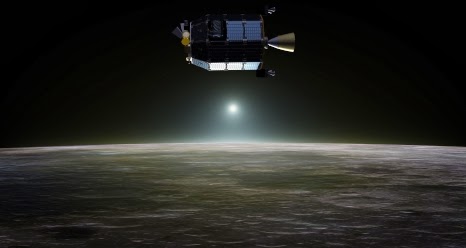
Already on duty orbiting the moon is NASA’s Lunar Atmosphere and Dust Environment Explorer (LADEE). The probe’s science instrument commissioning is now underway, after which the spacecraft will drop down to the lower lunar science orbit and start the full science phase of the mission. [NASA's LADEE Moon Mission in Photos]

LADEE Readies for Orbital Maneuvering Thruster Burn
Credit: NASA Ames/Dana Berry


LADEE is designed to study the moon’s thin exosphere and the lunar dust environment. However, there is concern that China’s ambitious Chang’e 3 mission could impact LADEE’s science goals.

Continue Learning: http://www.space.com/23675-china-moon-lander-trouble-nasa-ladee.html
Related articles
NASA Spacecraft Begins Collecting Lunar Atmosphere Data (askkuiper.wordpress.com)
NASA Moon Probe Laser-Blasts Europe! (askkuiper.wordpress.com)

Thursday, November 21, 2013

NASA Spacecraft Begins Collecting Lunar Atmosphere Data

Nov. 21, 2013

Artist’s concept of NASA's Lunar Atmosphere and Dust Environment Explorer (LADEE) spacecraft
Image Credit: NASA Ames / Dana Berry
NASA's Lunar Atmosphere and Dust Environment Explorer (LADEE) is ready to begin collecting science data about the moon.

On Nov. 20, the spacecraft successfully entered its planned orbit around the moon's equator -- a unique position allowing the small probe to make frequent passes from lunar day to lunar night. This will provide a full scope of the changes and processes occurring within the moon's tenuous atmosphere.

LADEE now orbits the moon about every two hours at an altitude of eight to 37 miles (12-60 kilometers) above the moon's surface. For about 100 days, the spacecraft will gather detailed information about the structure and composition of the thin lunar atmosphere and determine whether dust is being lofted into the lunar sky.

"A thorough understanding of the characteristics of our lunar neighbor will help researchers understand other small bodies in the solar system, such as asteroids, Mercury, and the moons of outer planets," said Sarah Noble, LADEE program scientist at NASA Headquarters in Washington.

Scientists also will be able to study the conditions in the atmosphere during lunar sunrise and sunset, where previous crewed and robotic missions detected a mysterious glow of rays and streamers reaching high into the lunar sky.

“This is what we've been waiting for – we are already seeing the shape of things to come,” said Rick Elphic, LADEE project scientist at NASA's Ames Research Center in Moffett Field, Calif.

Continue Learning: http://www.nasa.gov/content/nasa-spacecraft-begins-collecting-lunar-atmosphere-data/#.Uo7JjfmKK-0

Wednesday, November 6, 2013

NASA Moon Probe Laser-Blasts Europe!

Photo Credit: esa.int

NASA’s LADEE probe entered lunar orbit last month ready to study the moon’s enigmatic exosphere — a region that holds some dusty secrets. But LADEE (which stands for Lunar Atmosphere and Dust Environment Explorer) isn’t your average satellite; it’s sporting a powerful laser and Europe is in its cross hairs!

Of course, this laser isn’t being used for nefarious (pew pew) purposes. It’s a brand new means of transmitting data through space, potentially revolutionizing how interplanetary communications will be carried out in the future.