Translate

Showing posts with label NASA. Show all posts

Thursday, December 26, 2013

NASA and JAXA Announce Launch Date for Global Precipitation Satellite

December 17, 2013
Artist concept of the Global Precipitation Measurement (GPM) Core Observatory satellite.
Image Credit: NASA's Goddard Space Flight Center
RELEASE 13-376

Environmental research and weather forecasting are about to get a significant technology boost as NASA and the Japan Aerospace Exploration Agency (JAXA) prepare to launch a new satellite in February.

NASA and JAXA selected 1:07 p.m. to 3:07 p.m. EST Thursday, Feb. 27 (3:07 a.m. to 5:07 a.m. JST Friday, Feb. 28) as the launch date and launch window for a Japanese H-IIA rocket carrying the Global Precipitation Measurement (GPM) Core Observatory satellite from JAXA’s Tanegashima Space Center.

GPM is an international satellite mission that will provide advanced observations of rain and snowfall worldwide, several times a day to enhance our understanding of the water and energy cycles that drive Earth’s climate. The data provided by the Core Observatory will be used to calibrate precipitation measurements made by an international network of partner satellites to quantify when, where, and how much it rains or snows around the world.

“Launching this core observatory and establishing the Global Precipitation Measurement mission is vitally important for environmental research and weather forecasting,” said Michael Freilich, director of NASA’s Earth Science Division in Washington. “Knowing rain and snow amounts accurately over the whole globe is critical to understanding how weather and climate impact agriculture, fresh water availability, and responses to natural disasters.”

With the addition of the new Core Observatory, the satellites in the GPM constellation will include the NASA-National Oceanic and Atmospheric Administration (NOAA) Suomi National Polar-orbiting Partnership mission, launched in 2012; the NASA-JAXA Tropical Rainfall Measuring Mission (TRMM), launched in 1997; and several other satellites managed by JAXA, NOAA, the U.S. Department of Defense, the European Organisation for the Exploitation of Meteorological Satellites, the Centre National D’Etudies Spatiales of France and the Indian Space Research Organisation.

“We will use data from the GPM mission not only for Earth science research but to improve weather forecasting and respond to meteorological disasters,” said Shizuo Yamamoto, executive director of JAXA. “We would also like to aid other countries in the Asian region suffering from flood disasters by providing data for flood alert systems. Our dual-frequency precipitation radar, developed with unique Japanese technologies, plays a central role in the GPM mission.”

The GPM Core Observatory builds on the sensor technology developed for the TRMM mission, with two innovative new instruments. The GPM Microwave Imager, built by Ball Aerospace and Technology Corp., Boulder, Colo., will observe rainfall and snowfall at 13 different frequencies. The Dual-frequency Precipitation Radar, developed by JAXA with the National Institute of Information and Communication Technology in Tokyo, transmits radar frequencies that will detect ice and light rain, as well as heavier rainfall. It also will be able to measure the size and distribution of raindrops, snowflakes and ice particles.

(Learn More at Ask Kuiper)

For more information on the Global Precipitation Measurement mission, visit:

http://www.nasa.gov/gpm

and

http://www.jaxa.jp/projects/sat/gpm/index_e.html

Thursday, December 5, 2013

Goddard Planetary Instruments Score a Hat Trick

Dec. 5, 2013
Three mass spectrometers built at Goddard were operating on the same day at the moon, on Mars and en route to Mars.
Image Credit: NASA

Planetary instruments from NASA’s Goddard Space Flight Center in Greenbelt, Md., hit the trifecta on Dec. 4, running three experiments of the same kind at different places in space.

The instruments, all flying on NASA missions, are mass spectrometers, designed to take in atmospheric, rock or soil samples and identify particular molecules in them. The investigations lined up because of the operating schedules for the three, which must take turns with other instruments on their respective spacecraft.

“At the moon and Mars and part way in between, we had three mass spectrometers happily operating in their other-worldly environments or being checked out for the first time in space on the same day,” said Paul Mahaffy, the principal investigator for the instruments.

Goddard’s Planetary Environments Lab, headed by Mahaffy, built all three instruments. The mass spectrometers identify gases in atmospheric samples or gases that get released from rock or soil samples as they are processed. To pick out individual components in a sample, an electron beam is used to break the large molecules into smaller fragments. Then high-frequency electric fields are applied to the resulting mixture to sort the fragments by mass and electric charge, producing a fingerprint of the molecules present.

Stationed at the moon was NASA’s Lunar Atmosphere and Dust Environment Explorer, or LADEE, which entered an equatorial orbit on Nov. 20 and began science operations the following day. On Dec. 4, the mission’s Neutral Mass Spectrometer was checking out the moon’s thin atmosphere. The instrument will continue to collect samples over multiple orbits with the moon in different space environments.

En route to Mars was NASA’s Mars Atmosphere and Volatile Evolution, or MAVEN, mission. Launched on Nov. 18, the spacecraft is in the early cruise phase and is scheduled to arrive at the Red Planet in September 2014. The mission’s Neutral Gas and Ion Mass Spectrometer was turned on for the first time on Dec. 4 and measured calibration gases in the instrument.

Upon the spacecraft’s arrival at Mars, the instrument will study the planet’s fragile upper atmosphere, examining its composition and determining how quickly some of the gases are escaping into space over time. This information will help scientists understand what the Martian atmosphere looked like billions of years ago and how most of it has been lost since then.

On the surface of Mars was NASA’s Mars Science Laboratory’s Curiosity rover, which carries the Sample Analysis at Mars (SAM) instrument suite. SAM has been analyzing multiple samples of the atmosphere and soils and rocks to help scientists understand how habitable Mars was in the past.

“With these studies, mass spectrometry is helping us piece together the histories of the moon and Mars and offers a vision of their futures,” said Mahaffy. “It’s a perfect example of how invaluable these instruments are for space science.”

MAVEN's principal investigator is based at the University of Colorado Laboratory for Atmospheric and Space Physics in Boulder. Goddard manages the MAVEN mission. NASA’s Jet Propulsion Laboratory, a division of the California Institute of Technology in Pasadena, Calif., built the Curiosity rover and manages the Mars Science Laboratory Project. NASA's Ames Research Center at Moffett Field in California manages the LADEE mission.

By Elizabeth Zubritsky, NASA

(www.nasa.gov)

Related article
NASA | Alien Atmospheres (askkuiper.wordpress.com)

Tuesday, December 3, 2013

Laser communication mission targets 2017 launch

December 3, 2013

This is an artist rendering of the Laser Communications Relay Demonstration hosted aboard a Space Systems Loral commercial communications satellite.
Credit: Space Systems/Loral
NASA's next laser communication mission recently passed a Preliminary Design Review (PDR), another major milestone towards the launch of the Laser Communications Relay Demonstration (LCRD) scheduled for 2017.

The PDR is a major agency evaluation milestone of the engineering plan to execute the build and launch of LCRD onboard a Space Systems Loral commercial satellite. "The board concluded that the LCRD review was a resounding success," said Tupper Hyde, chairperson of the PDR. "They met all review success criteria and the LCRD team is ready to proceed with mission plans to conduct this ground-breaking demonstration."

The LCRD project is NASA's first long duration optical communications mission. This demonstration will build from NASA's highly successful Lunar Laser Communications Demonstration (LLCD) mission. LCRD will conduct a two-year demonstration of optical relay services to determine how well the system operates and collect long-term performance data. The Goddard team leads the project with significant support from MIT Lincoln Laboratory, NASA's Jet Propulsion Laboratory, and Space Systems/Loral (SSL).

Continue Learning: http://phys.org/news/2013-12-laser-mission.html

Spacesuit of the future could power gadgetry with body heat

by Elizabeth Armstrong Moore December 3, 2013 10:33 AM PST

Researchers at Kansas State are investigating how the difference in temperature between body heat and a spacesuit's cooling garment could run the suit's electronics.

Kansas State engineering students work with a model spacesuit to explore the potential integration of wearable medical sensors.
Credit: Kansas State University
Wondering what's next in wearable electronics? Fitness trackers like the Fitbit Force and the Nike+ FuelBand SE may be fine for the earthbound, but for the astronauts among us, NASA's working on a different kind of fashionable circuitry.

At Kansas State University, researchers are just over two years into a three-year, $750,000 NASA grant to turn current spacesuits into even better readers of astronauts' vital signs -- and on top of that, make use of the inner workings of the suits themselves to power radios and other embedded electronics.

"Right now the spacesuits pretty much only measure heart rate," said William Kuhn, professor of electrical and computer engineering and part of the spacesuit team, which includes engineering professors and a dozen-plus students. "In this project we're focused on EMGs [electromyography] that can monitor muscle activity. The biggest problem that the astronauts have when they're doing their work is they get very fatigued because of the pressure in the suits, so we're focusing on being able to predict when they're going to be fatigued so we can help them reorder their tasks in space."

Continue Learning: http://news.cnet.com/8301-11386_3-57613825-76/spacesuit-of-the-future-could-power-gadgetry-with-body-heat/

Monday, December 2, 2013

Spacelab: Space Shuttle Flew Europe's First Space Module 30 Years Ago

by Robert Z. Pearlman, collectSPACE.com Editor | December 02, 2013 01:17pm ET

The European Space Agency's (ESA) Spacelab module is seen in the payload bay of space shuttle Columbia during the lab's first spaceflight on the STS-9 mission in 1983.
Credit: NASA/RetroSpaceImages.com
It doesn't seem out of place today, but the sight 30 years ago of a cylindrical module mounted inside the space shuttle's cargo bay was described as an "odd-appearing assemblage" in 1983.

The unusual payload was Spacelab, a $1 billion European built, NASA-operated space-borne science platform, which would not only set the stage for investigations onboard the space shuttle, but would lay the foundation for major parts of today's International Space Station.

Space shuttle Columbia launched on Nov. 28, 1983, lifting into orbit the Spacelab and six astronauts. Under the lead of commander John Young, the STS-9 crew included pilot Brewster Shaw and mission specialists Owen Garriott and Robert Parker.

Continue Learning: http://www.space.com/23796-spacelab-space-shuttle-30-years-anniversary.html

Sunday, December 1, 2013

NASA Issues Human Exploration Rover Challenge To Students

November 30, 2013

Image Credit: Thinkstock.com
Susan Bowen for redOrbit.com – Your Universe Online

Students, some of whom will have only recently earned their driver’s licenses, will soon have the opportunity to test drive vehicles for use on other planets, asteroids, moons and comets.

NASA has issued a new engineering design challenge for teams of high school and college students: to design, build and test vehicles on the simulated surface of another world.

Registration for the NASA Human Exploration Rover Challenge will be open until early in 2014 and will provide students with an authentic engineering challenge.

“We designed this engineering challenge to align with NASA’s commitment of sending humans to Mars by the 2030s,” said Rocky Lind, who manages education and outreach efforts in the Human Exploration and Operations Mission Directorate at NASA Headquarters in Washington. “The student teams will be timed, ranked and scored based on design, safety and how well they traverse the set course. The results of the competition will contribute to the design process for NASA’s future exploration goals.”

Continue Learning: http://www.redorbit.com/news/space/1113016275/stem-nasa-human-exploration-rover-challenge-113013/

Related articles

Wednesday, November 27, 2013

3D virtual tour of the International Space Station

Published on Nov 19, 2013

Put your 3D glasses on for this virtual visit of the International Space Station's modules. Float through the space laboratories and connecting modules from the perspective of an astronaut.

(See More Videos)

Tuesday, November 26, 2013

Hi-Def Space Selfies Coming To Your Web Browser Soon

Posted by Andrew Fazekas in StarStruck on November 25, 2013

Space buffs can expect to to ogle stunning near-real-time Earth views anytime on their computers and mobile devices once new HD cameras are installed on the International Space Station.
Credit: NASA
Coming soon—take the ultimate selfie from space!

Two high-definition cameras are on their way now to the International Space Station. There, they will aim to revolutionize how we view our planet and ourselves.

A Canadian-based company named UrtheCast will offer the world’s first near-live HD video and imagery of Earth from space, using the new cameras. Launched aboard a Russian Soyuz spacecraft on Monday, the two eyes in the sky will be installed on the underbelly of the space station over the next few months. Expectations are that space buffs everywhere with an internet connection will see the first live streaming-video broadcast from the cameras on the company’s web portal early next year.

One of the cameras will offer sharp five-meter resolution stills of a broad 25-mile-wide (40 kilometer) swath of the globe, with pictures taken anywhere between 51°N and 51°S latitude (from England to Chile). The other camera can be pointed at 150 specific targets of interest per day. It has the capability of generating video with super-sharp Ultra-HD or 4K quality, and offers one-meter resolution.

Continue Learning: http://newswatch.nationalgeographic.com/2013/11/25/hi-def-space-selfies-coming-to-your-web-browser-soon/


Related articles

Monday, November 25, 2013

Cut-rate SpaceX poised for first commercial satellite launch

BY IRENE KLOTZ
CAPE CANAVERAL, Florida Mon Nov 25, 2013 11:40am EST

SEPTEMBER 29, 2013 PHOTO CREDIT — SPACEX
FALCON 9 CLOSE UP
(Reuters) - - An unmanned Falcon 9 rocket developed by Space Exploration Technologies, or SpaceX, is poised to enter the commercial satellite market on Monday, a potential game-changer in a global industry worth nearly $190 billion a year.

Following a successful debut test fight on September 29, the privately owned firm's upgraded Falcon 9 rocket is due to lift off at 5:37 p.m. EST/2237 GMT from Cape Canaveral Air Force Station in Florida.

Perched on top of the rocket is a 6,400-pound (2,900 kg) communications satellite owned by Luxembourg-based SES S.A., which currently operates a 54-satellite fleet, the world's second-largest.

The satellite, known as SES-8 and worth about $100 million, will be positioned to provide television, cable, broadband and other services to customers in India, China, Vietnam and other markets in Asia.

"It's an extremely important satellite for us," Martin Halliwell, chief technology officer of SES, told reporters on Sunday in Cocoa Beach, Florida.

"We know that as we go forward into these very significant growth markets that it's absolutely critical that we have a cost-effective and efficient way to get to orbit. That's really what SpaceX has brought us," Halliwell said.

Previous SES satellites were launched primarily aboard Russian Proton and European Ariane rockets, which cost far more than the approximately $55 million the company paid for its ride on SpaceX's Falcon booster, Halliwell said.

He would not say exactly how much SpaceX undercut the competition, but did say SES got a bit of a discount by agreeing to fly on Falcon 9's first mission to the high altitudes that communication satellites require.

In addition to the upgraded Falcon 9's test flight in September, older versions of the rocket previously flew five times successfully, including three missions for NASA to deliver cargo to the International Space Station, which flies about 250 miles above Earth.

Continue Learning: http://www.reuters.com/article/2013/11/25/us-space-spacex-launch-idUSBRE9AO0NN20131125

SES-8 Satellite Launch Will Be SpaceX’s Most Challenging To Date

November 25, 2013

A September test launch of SpaceX’s Falcon 9 rocket. Credit: SpaceX
Lawrence LeBlond for redOrbit.com – Your Universe Online

SpaceX is preparing for its next big mission this evening when it will, for the first time, attempt to launch a telecom satellite into orbit. A successful launch could prove the Elon Musk-owned company’s worth as both a private and commercial powerhouse in the space launch game.

The launch window for SpaceX’s Falcon 9 opens today at 5:37 p.m. EST from Cape Canaveral, Florida. The rocket will be carrying a Luxembourg-based SES-8 satellite that will serve television customers in India and parts of Southeast Asia.

The launch of a satellite is not only a first for SpaceX, but will also be its most challenging. The Falcon 9 rocket must show its capabilities in launching the SES-8 satellite into a geostationary transfer orbit more than 22,000 miles over Earth’s equator.

Today’s launch of an upgraded Falcon 9 rocket, known as version 1.1, also comes after a September 29 test launch of the same rocket design in California. While that test was successful, an optional restart of the rocket’s upper stage engine, which will be necessary for the latest mission, failed to activate.

SpaceX later determined that an igniter line froze and believes that added insulation will prevent a repeat of the issue.

“We’ve done everything we can possibly think of to maximize the reliability of this launch,” Musk, CEO and chief designer at SpaceX, told BBC’s Jonathan Amos in an interview

“There’s no stone that hasn’t been turned over at least twice to maximize the probability of success. Being a rocket, there’s still some chance of failure, but whatever happens we can be at peace that we’ve done everything we could think of, and SES’s technical team has looked at it and they concur,” Musk added.

Continue Learning: http://www.redorbit.com/news/space/1113012115/spacex-launch-commercial-satellite-tonight-most-challenging-112513/

NASA Launches Technology Transfer 'Super Tool'

Nov. 25, 2013

Sarah Ramsey
Headquarters, Washington
202-358-1694
sarah.ramsey@nasa.gov

RELEASE 13-347

Businesses and individuals interested in using NASA research to develop new technologies and products now have access to an online tool to make the process of licensing easier.

The QuickLaunch licensing tool provides access to a select portfolio of NASA technologies for the purpose of licensing and commercial development.

The tool features pre-approved terms and conditions, including fixed, up-front and royalty pricing, a streamlined process for electronic agreements and significantly reduced response and approval times. It provides access to existing, patented NASA technologies to provide rapid and cost-effective deployment to industry.

"The QuickLaunch Licensing tool will enhance our efforts to transfer more NASA technologies to American industry and U.S. consumers in a timely manner," said Daniel Lockney, NASA's technology transfer program executive. "NASA develops hundreds of technologies each year in support of its aeronautics and space exploration missions. This new tool ensures that the American taxpayer will receive a second benefit from its investment in NASA through the creation of new products, new markets and new jobs."

More than 30 technologies currently are available for license using the QuickLaunch website. The number will increase during the coming year. Technologies range from a plant chlorophyll content meter, which detects plant stress by determining the chlorophyll content of plants, to a propulsion-controlled aircraft computer that provides a low-cost method of implementing this aircraft technology for a wide range of aircraft.

QuickLaunch users can search by NASA center or by technology category, ask questions of NASA licensing managers, and file a licensing application online.

For more information about NASA's QuickLaunch Licensing website, please visit:

https://quicklaunch.ndc.nasa.gov

For more information about NASA's Technology Transfer Portal website, visit:

http://technology.nasa.gov

NASA Delivers Precipitation Satellite to Japan for 2014 Launch

Nov. 25, 2013

Steve Cole
Headquarters, Washington
202-358-0918
stephen.e.cole@nasa.gov

Rani Gran
Goddard Space Flight Center, Greenbelt, Md.
301-286-2483
rani.c.gran@nasa.gov

RELEASE 13-346

A U.S. Air Force C-5 transport aircraft carrying the Global Precipitation Measurement (GPM) Core Observatory landed at Kitakyushu Airport in Japan at approximately 10:30 p.m. EST Saturday, Nov. 23.
(Credit: JAXA)
An international satellite that will set a new standard for global precipitation measurements from space has completed a 7,300-mile journey from the United States to Japan, where it now will undergo launch preparations.

A U.S. Air Force C-5 transport aircraft carrying the Global Precipitation Measurement (GPM) Core Observatory landed at Kitakyushu Airport, about 600 miles southwest of Tokyo, at approximately 10:30 p.m. EST Saturday, Nov. 23.

The spacecraft, the size of a small private jet, is the largest satellite ever built at NASA’s Goddard Space Flight Center in Greenbelt, Md. It left Goddard inside a large shipping container Nov. 19 and began its journey across the Pacific Ocean Nov. 21 from Joint Base Andrews in Maryland, with a refueling stop in Anchorage, Alaska.

From Kitakyushu Airport, the spacecraft was loaded onto a barge heading to the Japan Aerospace Exploration Agency's (JAXA's) Tanegashima Space Center on Tanegashima Island in southern Japan, where it will be prepared for launch in early 2014 on an H-IIA rocket.

Continue Learning...

Saturday, November 23, 2013

MAVEN is on the way on This Week @NASA


Published on Nov 22, 2013

The Mars Atmosphere and Volatile EvolutioN, or MAVEN spacecraft launched from Cape Canaveral Air Force Station in Florida on a 10-month journey to Mars. MAVEN will take critical measurements of the Martian upper atmosphere to investigate how loss of the atmosphere to space impacted the history of water on the planet's surface. Also, Happy anniversary, ISS!, Asteroid Ideas, LADEE in science orbit, Orion progress, Rocket autopilot test, Commercial crew, and more!

(See more videos)

2014 NASA Rover Challenge

2014 NASA Rover Challenge
NASA is introducing a new engineering design challenge that will focus on NASA’s current plans to explore planets, moons, asteroids and comets -- all members of the solar system family. The new NASA Rover Challenge (formerly NASA Great Moonbuggy Race) will be held April 10-12, 2014, at the U. S. Space & Rocket Center. The challenge will focus on designing, constructing and testing technologies for mobility devices to perform in these different environments, and it will provide valuable experiences that engage students in the technologies and concepts that will be needed in future exploration missions. Registration is OPEN!

Visit the registration section of this site for details.

Is Inspiration Enough To Launch Inspiration Mars?

NASA By Amy Shira Teitel Posted Nov. 22, 2013

An artist’s concept of Inspiration Mars Inspiration Mars
Credit: Inspiration Mars
In 2001, Dennis Tito used his millions to buy a seat on a Soyuz spacecraft for an eight-day visit to the International Space Station. On February 27 of this year, he announced his plan to foot a large portion of the bill for Inspiration Mars, a flyby mission to the red planet. On Wednesday in front of a House Committee on Space, he called for NASA to pick up the slack to see his mission fly, both financially and technologically. Inspiration Mars had some obvious problems from the start, but this latest development looks a little like it might be the first nail in the mission’s coffin.

Tito unveiled Inspiration Mars earlier this year as a philanthropic mission; technological and scientific ends were secondary to the primary goal of inspiring the nation to aspire to great things in space once again. The mission itself is fairly straightforward. A crew of two (a married, middle-aged, heterosexual couple) will launch in January of 2018, fly to Mars, and whip around the planet’s far side using gravity to boost them back to Earth. The mission isn’t designed to land on Mars of even go into orbit. It would be a 501 day flight with a very short but exciting flyby around one of our neighbours.

Continue Learning: http://www.popsci.com/blog-network/vintage-space/inspiration-enough-launch-inspiration-mars

Clock Ticking for 2018 Private Manned Mars Mission

By Mike Wall, Senior Writer | November 21, 2013 06:00am ET

An artist’s illustration of the manned spacecraft for the Inspiration Mars
mission to send two astronauts on a Mars flyby mission in 2017-2018.
Credit: Inspiration Mars
A private manned Mars mission won’t get off the ground as planned in January 2018 unless it secures the support of the federal government within the next few months, officials say.

The nonprofit Inspiration Mars Foundation aims to partner with NASA to send two astronauts on a flyby mission to the Red Planet in 2018. Inspiration Mars has little chance of making this launch date unless it receives assurances very soon from Congress and the White House that the mission will be a NASA priority, officials said.

“We have a just a couple of months to get some signals that would indicate that there’s serious interest developing,” Inspiration Mars founder Dennis Tito, who became the world’s first space tourist when he paid his own way to the International Space Station in 2001, told reporters during a teleconference Wednesday (Nov. 20). “So, not much time.” [Private Mission to Mars Explained (Infographic)]

Inspiration Mars’ “Mission for America” would launch a married couple on a 501-day flyby mission to the Red Planet in January 2018. The astronauts would not land on Mars, but would streak within 100 miles (160 kilometers) of its surface before beginning the long trek back to Earth.

The mission would lay the foundation for even more ambitious exploration efforts in the future and help cement the United States’ status as a global leader in science and technology by inspiring the next generation of researchers and engineers, Inspiration Mars officials say.

Continue Learning: http://www.space.com/23678-inspiration-mars-manned-mission-deadline.html

NASA | How to Cook a Comet


Published on Nov 21, 2013

(See More Videos)

A comet's journey through the solar system is perilous and violent. Before it reaches Mars - at some 230 million miles away from the sun - the radiation of the sun begins to cook off the frozen water ice directly into gas. This is called sublimation. It is the first step toward breaking the comet apart. If it survives this, the intense radiation and pressure closer to the sun could destroy it altogether.

Animators at NASA's Goddard Space Flight Center in Greenbelt, Md. created this short movie showing how the sun can cook a comet.

Such a journey is currently being made by Comet ISON. It began its trip from the Oort cloud region of our solar system and is now traveling toward the sun. The comet will reach its closest approach to the sun on Thanksgiving Day -- Nov. 28, 2013 -- skimming just 730,000 miles above the sun's surface. If it comes around the sun without breaking up, the comet will be visible in the Northern Hemisphere with the naked eye, and from what we see now, ISON is predicted to be a particularly bright and beautiful comet.

Even if the comet does not survive, tracking its journey will help scientists understand what the comet is made of, how it reacts to its environment, and what this explains about the origins of the solar system. Closer to the sun, watching how the comet and its tail interact with the vast solar atmosphere can teach scientists more about the sun itself.

This video is public domain and can be downloaded at: http://svs.gsfc.nasa.gov/goto?11384

Like our videos? Subscribe to NASA's Goddard Shorts HD podcast:
http://svs.gsfc.nasa.gov/vis/iTunes/f...

Or find NASA Goddard Space Flight Center on Facebook:
http://www.facebook.com/NASA.GSFC

Or find us on Twitter:
http://twitter.com/NASAGoddard

Friday, November 22, 2013

China's 1st Moon Lander May Cause Trouble for NASA Lunar Dust Mission

by Leonard David, SPACE.com's Space Insider Columnist | November 21, 2013 06:45am ET

The Chang’e 3 lunar lander and moon rover
Credit: Beijing Institute of Spacecraft System Engineering
China’s mission to robotically land on the moon next month is sure to stir up lunar dust, but it may also cause a political dust up, too.

China is in the final stages of preparing its robotic Chang’e 3 moon lander to launch atop a Long March 3B rocket, slated for liftoff in early December. The ambitious mission is built to first orbit the moon, then propel down to a landing site, after which a small, solar-powered lunar rover will be unleashed.

Already on duty orbiting the moon is NASA’s Lunar Atmosphere and Dust Environment Explorer (LADEE). The probe’s science instrument commissioning is now underway, after which the spacecraft will drop down to the lower lunar science orbit and start the full science phase of the mission. [NASA's LADEE Moon Mission in Photos]

LADEE Readies for Orbital Maneuvering Thruster Burn
Credit: NASA Ames/Dana Berry


LADEE is designed to study the moon’s thin exosphere and the lunar dust environment. However, there is concern that China’s ambitious Chang’e 3 mission could impact LADEE’s science goals.

Continue Learning: http://www.space.com/23675-china-moon-lander-trouble-nasa-ladee.html
Related articles
NASA Spacecraft Begins Collecting Lunar Atmosphere Data (askkuiper.wordpress.com)
NASA Moon Probe Laser-Blasts Europe! (askkuiper.wordpress.com)

NASA sees 'watershed' cosmic blast in unique detail

Posted: Nov 21, 2013 by Francis Reddy

In the most common type of gamma-ray burst, illustrated here, a dying massive star forms a
black hole (left), which drives a particle jet into space.
Credit: NASA's Goddard Space Flight Center
(Phys.org) —On April 27, a blast of light from a dying star in a distant galaxy became the focus of astronomers around the world. The explosion, known as a gamma-ray burst and designated GRB 130427A, tops the charts as one of the brightest ever seen

A trio of NASA satellites, working in concert with ground-based robotic telescopes, captured never-before-seen details that challenge current theoretical understandings of how gamma-ray bursts work.

"We expect to see an event like this only once or twice a century, so we're fortunate it happened when we had the appropriate collection of sensitive space telescopes with complementary capabilities available to see it," said Paul Hertz, director of NASA's Astrophysics Division in Washington.

Gamma-ray bursts are the most luminous explosions in the cosmos, thought to be triggered when the core of a massive star runs out of nuclear fuel, collapses under its own weight, and forms a black hole. The black hole then drives jets of particles that drill all the way through the collapsing star and erupt into space at nearly the speed of light.

Gamma-rays are the most energetic form of light. Hot matter surrounding a new black hole and internal shock waves produced by collisions within the jet are thought to emit gamma-rays with energies in the million-electron-volt (MeV) range, or roughly 500,000 times the energy of visible light. The most energetic emission, with billion-electron-volt (GeV) gamma rays, is thought to arise when the jet slams into its surroundings, forming an external shock wave.

The Gamma-ray Burst Monitor (GBM) aboard NASA's Fermi Gamma-ray Space Telescope captured the initial wave of gamma rays from GRB 130427A shortly after 3:47 a.m. EDT April 27. In its first three seconds alone, the "monster burst" proved brighter than almost any burst previously observed.

Continue Learning: http://phys.org/news/2013-11-nasa-watershed-cosmic-blast-unique.html
Related articles
Infant Galaxies Merge Near 'Cosmic Dawn' (askkuiper.wordpress.com)
Ames to pitch NASA on value of 'new' Kepler mission (askkuiper.wordpress.com)
NASA Spacecraft Begins Collecting Lunar Atmosphere Data (askkuiper.wordpress.com)

Thursday, November 21, 2013

NASA Spacecraft Begins Collecting Lunar Atmosphere Data

Nov. 21, 2013

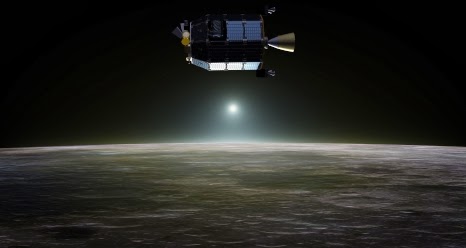
Artist’s concept of NASA's Lunar Atmosphere and Dust Environment Explorer (LADEE) spacecraft
Image Credit: NASA Ames / Dana Berry
NASA's Lunar Atmosphere and Dust Environment Explorer (LADEE) is ready to begin collecting science data about the moon.

On Nov. 20, the spacecraft successfully entered its planned orbit around the moon's equator -- a unique position allowing the small probe to make frequent passes from lunar day to lunar night. This will provide a full scope of the changes and processes occurring within the moon's tenuous atmosphere.

LADEE now orbits the moon about every two hours at an altitude of eight to 37 miles (12-60 kilometers) above the moon's surface. For about 100 days, the spacecraft will gather detailed information about the structure and composition of the thin lunar atmosphere and determine whether dust is being lofted into the lunar sky.

"A thorough understanding of the characteristics of our lunar neighbor will help researchers understand other small bodies in the solar system, such as asteroids, Mercury, and the moons of outer planets," said Sarah Noble, LADEE program scientist at NASA Headquarters in Washington.

Scientists also will be able to study the conditions in the atmosphere during lunar sunrise and sunset, where previous crewed and robotic missions detected a mysterious glow of rays and streamers reaching high into the lunar sky.

“This is what we've been waiting for – we are already seeing the shape of things to come,” said Rick Elphic, LADEE project scientist at NASA's Ames Research Center in Moffett Field, Calif.

Continue Learning: http://www.nasa.gov/content/nasa-spacecraft-begins-collecting-lunar-atmosphere-data/#.Uo7JjfmKK-0